
Introduction
Fledermaus provides several methods for calculating slope on gridded surfaces. This page describes how each method determines slope values and helps you choose the one that best matches your analysis needs.
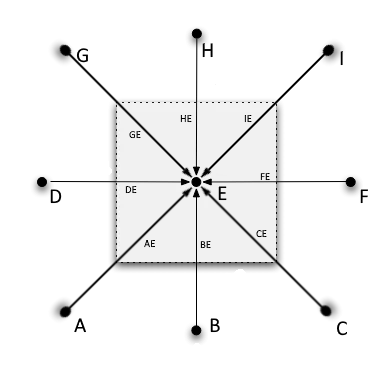
This page describes the three methods Fledermaus uses to calculate slope at a given grid cell. The explanations reference the diagram below, where E represents the center cell and A–I represent the center points of the eight surrounding cells in the cardinal and intercardinal directions.
The shaded region indicates the physical size of the grid cell at E. Because all points represent cell centers, the horizontal distance from E to any neighbor (e.g., AE, DE, HE) is equal to the grid cell size.
Fitted Plane Slope Calculation
The Fitted Plane method computes a “plane of best fit” using the elevations of the center cell and its surrounding neighbors. A least‑squares plane is fitted through these points, and the slope of that plane is assigned to cell E.
This approach provides a smooth and robust slope estimate because it considers all available neighboring elevations simultaneously.
Balanced Slope Calculation
The Balanced method computes slope along two perpendicular lines that pass through point E:
-
The DF direction (east–west)
-
The BH direction (north–south)
The slopes from these two lines are averaged to produce the final slope value for E.
Optionally, the user can choose a specific cardinal direction instead of averaging. In this case, the slope calculated along the selected line (e.g., the east–west or north–south direction) becomes the slope for E.
Simple Slope Calculation
The Simple method computes the slope between E and each of its eight surrounding cells. These individual slope values can then be combined in several ways:
-
Average of all surrounding slopes
-
Minimum slope
-
Maximum slope
-
Directional slope (using a specific cardinal direction)
Once the horizontal and vertical components are known, the slope angle is calculated using the arctangent function and converted to degrees.
It is important to note that each grid cell computes slope independently, so two adjacent cells may report different slope values even if their surrounding geometry is similar.
Additional Information
-
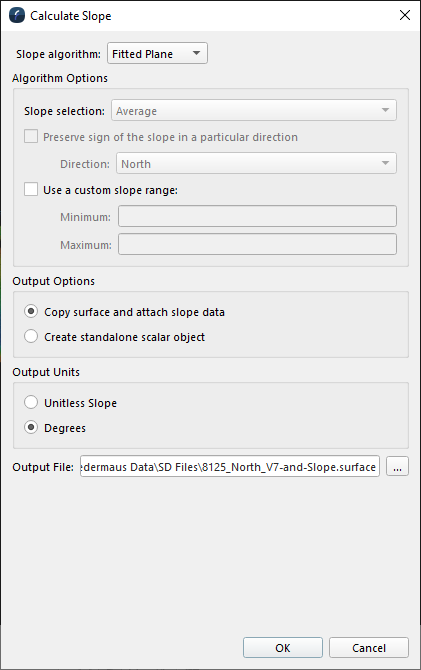
https://qpssoftware.scrollhelp.site/fledermaus/fledermaus-calculate-slope-dialog
-
https://qpssoftware.scrollhelp.site/fledermaus/how-to-calculate-a-slope