
On this page:
Overview:
This dialog is launched via the Fledermaus Visual Objects, Operations, & Exports. This option allows the current selected Dynamic Surface to be exported to a bag surface.
Page 1
The first screen in the series of pages in this wizard prompts for the depth layer and uncertainty layer to use to create the BAG file. The options for Attached Scalars and Loaded Scalar (.scalar) Object will be available if there are scalars attached to the surface or in the scene, respectively.
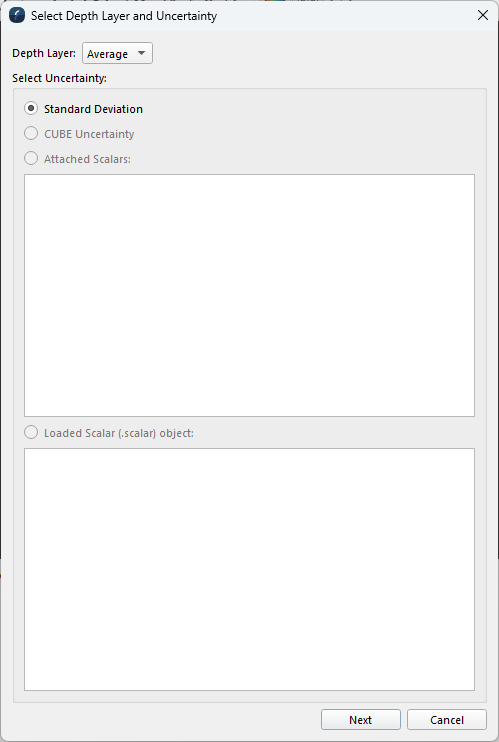
The "Depth Layer" dropdown specifies the depth layer to export during the BAG export process. This dropdown menu is automatically populated with the depth layer currently displayed based on what is selected in the Fledermaus Scene Objects Dock.
The "Select Uncertainty" radio button is initially configured based on what is selected in the Fledermaus Scene Objects Dock.
For example, if a single Dynamic Surface is selected but doesn't include CUBE, then "Standard Deviation" will be set initially. However, if a single Dynamic Surface is selected that includes CUBE then "CUBE Uncertainty" will be initially set.
|
Project Layers Selection |
Initial Radio Button Option |
|---|---|
|
Single Dynamic Surface |
Standard Deviation |
|
Single Dynamic Surface with CUBE |
CUBE Uncertainty |
|
Single Dynamic Surface with attached Scalar |
Attached Scalar |
|
Multiselect Dynamic Surface and Scalar Object (e.g. TVU) |
Loaded Scalar (.scalar) Object |
It is possible to override this option. For example, if CUBE Uncertainty is initially set, then it can be changed to Standard Deviation instead.
Some options may be unavailable. For example, if the current selected Dynamic Surface doesn't include CUBE, then the option for "CUBE Uncertainty" will be greyed out.
When multiselecting, the loaded scalar will be automatically selected from the list of available scalars. Alternatively, select a single dynamic surface, then pick a scalar from the list of loaded scalars after the fact.
When multiselecting more than one Dynamic Surface a batch export will be performed (Note: In this mode, the first page of the wizard is skipped).
If CUBE Uncertainty is selected, then the uncertainty layer will come from the CUBE surface.
|
Radio Button Option |
Resulting BAG Uncertainty |
|---|---|
|
Standard Deviation |
Surface Standard Deviation |
|
CUBE Uncertainty |
CUBE Surface Uncertainty |
|
Attached Scalar |
Surface Attached Scalar is used as Uncertainty |
|
Loaded Scalar (.scalar) object |
The Loaded Scalar is used as Uncertainty. |
Note that CUBE Uncertainty layer is different than the usual Dynamic Surface Uncertainty layer.
-
The regular Uncertainty layer for a Dynamic Surface reflects the standard deviation, scaled to 95% c.l., of all accepted soundings, regardless of whether or not they are used for a CUBE surface. It does not include rejected soundings in the calculation.
-
The CUBE Uncertainty layer reflects the standard deviation, scaled to 95% c.l., of the accepted soundings that contributed to the selected hypothesis.
In both cases, the standard deviation is scaled to 95% c.l. via the scaling factor of 1.96.
Page 2
This will launch a file browser to select the name for the exported BAG.
Page 3
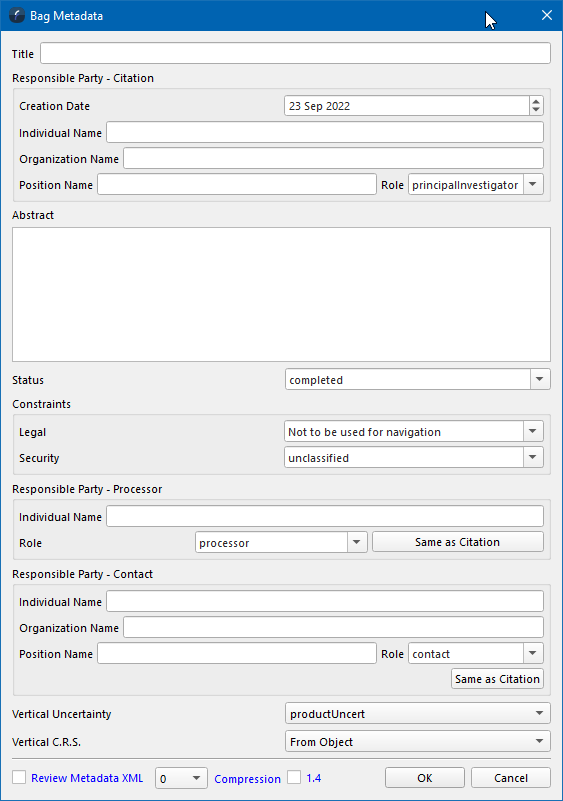
This dialog simply gathers all the metadata information that can be stored with a bag surface.
The Vertical Uncertainty tag will be initially set based on the option you chose on page 1:
For example, if "CUBE Uncertainty" was selected on page 1, then Vertical Uncertainty will be initially set to "cubeUncert" on page 2.
|
Page 1 Option |
Initial Vertical Uncertainty |
|---|---|
|
Standard Deviation |
rawStdDev |
|
CUBE Uncertainty |
cubeUncert |
|
Attached Scalar |
productUncert |
|
Loaded Scalar (.scalar) object |
productUncert |
It can still be changed from the dropdown.